
Multi-Cloud Strategy: A Business Risk
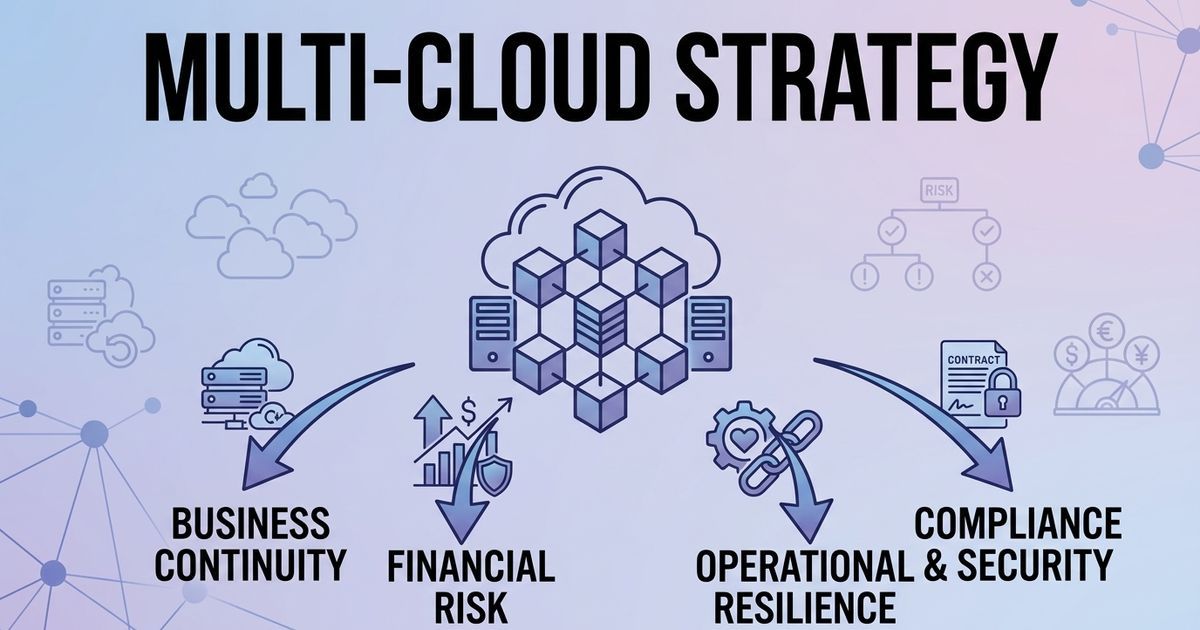

Multi-Cloud Strategy: A Business Risk Decision, Not Just a Technical One
Five years ago, "multi-cloud" was a slide in a technology conference keynote. Today it's how the large majority of enterprises actually operate — not because it's technically elegant, but because the alternative has become commercially intolerable.
Not sure if your cloud strategy is exposing you to unnecessary risk?
When a CTO proposes a multi-cloud strategy, it's often framed to leadership as a technical best practice — resilience, performance optimization, access to specialized services. Those benefits are real, but they undersell what's actually driving adoption at scale. The dominant reason enterprises are moving to multi-cloud isn't technical elegance. It's a straightforward business risk calculation: single-vendor dependency has become too expensive and too limiting to accept.
Stats That Matter
- 89% of enterprise organizations now use a multi-cloud strategy, according to Flexera's 2026 State of the Cloud Report.
- The top reason cited for multi-cloud adoption is avoiding vendor lock-in, named by 62-67% of organizations depending on the survey — well ahead of performance or cost optimization.
- 42% of companies are considering moving workloads back on-premises specifically to escape vendor dependencies that have become too costly or restrictive.
Why Vendor Lock-In Became a Board-Level Concern
In the early years of cloud adoption, standardizing on a single provider and accepting deep integration with its proprietary services was a reasonable trade-off for speed. That trade-off has changed. As cloud pricing has risen — particularly for data egress, managed services, and reserved capacity — enterprises deeply embedded in one provider have found themselves with very little negotiating leverage. A single vendor that knows switching would cost you millions in migration effort has little incentive to keep pricing competitive.
This is precisely why one cloud strategy director framed multi-cloud as no longer a choice but a necessity for enterprise agility — the language of strategic necessity, not technical preference. The stakes are large enough that some public-sector analyses have estimated overreliance on a single provider could cost hundreds of millions of pounds in lost negotiating leverage and unplanned cost exposure over time.
The Trade-Off Leadership Needs to Understand
Multi-cloud isn't a free lunch, and leadership should go in with clear eyes about what it costs to get the benefit. The very strategy meant to reduce vendor risk can, if poorly governed, spiral into a genuine operational headache — different dashboards, inconsistent security policies across providers, and unexpected fees that weren't visible when each cloud was evaluated in isolation.
This is the central tension of the decision: single-cloud is operationally simpler but commercially riskier. Multi-cloud is commercially safer but operationally more complex; if that complexity isn't actively managed, it introduces its own new risks — particularly around security consistency and cost visibility.
What Makes Multi-Cloud Work Instead of Backfire
The organizations executing multi-cloud successfully share a few specific disciplines, and leadership can use these as a checklist when evaluating whether a proposed multi-cloud initiative is set up to succeed or to create a new mess:
Providers are chosen for distinct strengths, not duplicated everywhere. Successful multi-cloud architectures assign workloads to whichever provider is genuinely best suited — one provider for infrastructure scale, another for specialized AI or analytics capability — rather than running everything redundantly across all providers, which multiplies cost and complexity without multiplying benefit.
Portability is built in from the start, not bolted on later. Multi-cloud forces the adoption of portable data formats and standardized APIs early, which is precisely what makes future migrations dramatically cheaper than in a deeply proprietary single-cloud environment. This investment pays for itself specifically the first time a vendor's pricing or terms change unfavorably.
Governance is centralized even though infrastructure is distributed. A single management and security posture across providers is what prevents multi-cloud complexity from becoming a security or cost blind spot. Without this, the "protection" multi-cloud offers against vendor risk gets partially offset by new operational risk that's harder to see across fragmented environments.
Compliance and Data Locality: The Underrated Driver
Beyond vendor risk, multi-cloud increasingly serves a compliance function that matters directly to regulated industries and any organization operating across multiple jurisdictions. Different regions carry different regulatory requirements around where data can be stored and processed, and a multi-cloud approach lets an organization place workloads in the jurisdictions with appropriate compliance frameworks rather than being constrained to wherever a single provider happens to have infrastructure. For organizations expanding internationally, this is frequently as important a driver as vendor risk itself.
What Leadership Should Ask Before Approving a Multi-Cloud Initiative
What specific risk are we solving for — cost leverage, compliance, resilience, or capability access? Multi-cloud proposed without a clear driver tends to become complexity without a corresponding benefit.
Do we have centralized governance and security visibility across providers, or will this fragment our security posture? This is the single biggest factor separating organizations that execute multi-cloud well from those that create an operational mess.
Have we built in portability, or are we simply recreating single-vendor lock-in across two providers instead of one? Multi-cloud only delivers negotiating leverage if workloads can genuinely move — deep proprietary integration with two vendors instead of one still leaves you locked in, just twice.
Key Takeaways
- 89% of enterprises now operate multi-cloud, driven primarily by the need to avoid vendor lock-in rather than pure technical preference.
- Single-vendor dependency has become a genuine commercial risk — reduced negotiating leverage, rising proprietary pricing, and limited flexibility to respond to changing terms.
- Multi-cloud reduces vendor risk but introduces operational complexity that must be actively governed, or it creates new security and cost visibility risks.
- Successful multi-cloud strategies assign workloads to providers based on distinct strengths, build in portability from the start, and centralize governance across providers.
- Leadership should evaluate multi-cloud proposals by the specific risk being solved for, not treat it as a default technical best practice to adopt everywhere uniformly.
What to Do Next
If your organization is considering multi-cloud, or already running it without centralized governance, that gap is worth closing before complexity outpaces the risk reduction you're trying to achieve.
I work with a trainer who specializes in exactly this: helping leadership and technical teams build the governance discipline that makes multi-cloud a genuine risk reducer rather than a new operational headache. If this is on your radar for the next quarter, call or contact me and I'll help you get started.